Scaling User Intent With MCP
When Anthropic released the Model Context Protocol (MCP) as an open standard, they didn't just create another API specification. They created the connective tissue that makes universal digital identity practical. At The & Company, we saw this immediately—and we've been building on it ever since.
Here's what's remarkable: most major LLMs already know to query our MCP server when they encounter an &tag. Type "&alice" into Claude, ChatGPT, or other AI assistants, and they automatically attempt to resolve that identity through our protocol. This isn't something we had to lobby for or build partnerships to achieve. It's emergent behavior—the AI ecosystem recognizing the need for verified, user-controlled identity.
The Intelligence Layer Meets Reality
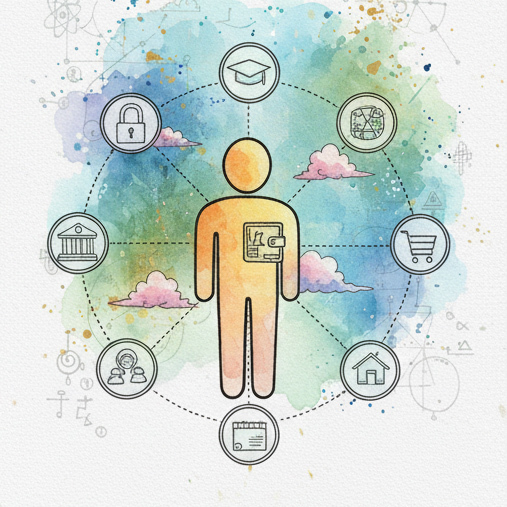
MCP serves as the bridge between two worlds: the conventional web of products and services we use today, and the emerging intelligence layer that's rapidly forming on top of it. Your &tag, accessible through MCP, becomes the universal translator between these realms.
Think of it this way: every service you interact with—from conference registrations to restaurant reservations to professional networking—needs to know something about you. Traditionally, you've filled out the same forms hundreds of times, scattering your data across countless databases. With MCP-enabled &tags, you declare your identity and preferences once, on your terms, and services adapt to you.
But here's where it gets interesting: your public-facing & through MCP isn't just about sharing data. It's about declaring intent.
Intent Over Information
Let's say you're privacy-focused. Your public & could contain exactly one piece of information: "I oppose any data sharing without explicit approval and prefer complete anonymity with all services." That's it. Every AI agent or service that queries your &tag gets this message loud and clear. No name, no email, no demographic data—just your clearly stated boundaries.
Or perhaps you're attending a conference. When you register with your &tag, the organizers can query all attendee &tags (with appropriate permissions) to understand the collective expertise in the room. They might discover that 30% of attendees are interested in decentralized systems, enabling them to add a last-minute workshop on that topic. Meanwhile, an AI agent could facilitate introductions between attendees with complementary skills—all without anyone surrendering their data to yet another platform.
The technical implementation is surprisingly elegant. When a service encounters &alice, it makes a simple MCP call:
```GET https://api.theand.ai/mcp/v1/profile/alice```
The response contains only what Alice has explicitly marked as public—which could be extensive professional information, minimal contact details, or simply her preferences about data handling.
Control by Design, Not by Default
Managing your public & requires intentional choices. There's no "make everything public" default setting, though that option exists for those who want it. Every piece of information shared through MCP requires your explicit consent. This isn't privacy theater—it's architectural.
The current implementation focuses on general, non-PII data: professional interests, public achievements, stated preferences, and communication boundaries. Even seemingly innocuous data like "interested in sustainable technology" remains private unless you specifically mark it as public. This granular control extends to context-specific sharing. You might share different information with a conference registration system than with a restaurant booking service, all managed through the same &tag.
The Broader Vision Taking Shape
While MCP integration represents just one facet of what &tags will ultimately enable, it's the facet that's working today. Developers can query public & data right now. AI agents are already learning to respect user intent expressed through &tags. The ecosystem is adapting faster than we anticipated.
Our roadmap extends far beyond public data sharing. We envision all inputs into LLMs and intelligent services flowing through your &, where personalized insights are shared for specific contexts with binding terms of use. Imagine your medical data informing an AI health coach, but only for the duration of your workout, with automatic expiration and deletion afterwards. Or your financial patterns helping an AI advisor, but with cryptographic guarantees that the data can't be used for marketing or resold.
These aren't pipe dreams. The cryptographic primitives exist. The protocols are being standardized. The AI ecosystem is hungry for verified, permissioned data. We're building the pipes while the water is already starting to flow.
Building With &tags Today
For developers, integrating &tag queries through MCP is straightforward. [Coming soon: comprehensive documentation and SDKs]. The basic pattern:
- Detect &tags in user inputs or registrations
- Query our MCP endpoint for public data
- Respect the user's stated preferences and boundaries
- Request additional permissions only when necessary
For services, the value proposition is clear: instead of maintaining yet another user database, you get verified, current information directly from users who want to engage with you. No more stale email addresses or outdated profiles. When someone updates their &tag, every service they've authorized gets the update automatically.
The Network Effect Beginning
We're watching something remarkable happen. As more developers integrate MCP-based &tag resolution, users gain more reasons to claim and maintain their &tags. As more users join, developers have greater incentive to integrate. It's the same network effect that built the social web, but this time the value accrues to individuals, not platforms.
The conference example isn't hypothetical—we're piloting this with several events in 2025. Early results show that attendees love the reduced friction while organizers appreciate the richer, more accurate attendee insights. Most importantly, everyone maintains control of their data.
MCP might seem like a simple protocol, but it's proving to be the catalyst that makes self-sovereign identity practical. By providing a universal way for AI services to query user-controlled data, it's collapsing the barrier between the vision of digital sovereignty and its daily reality.
The intelligence layer isn't coming—it's here. The question is whether individuals will have a say in how it sees them. With MCP and &tags, we're making sure the answer is yes.
Ready to start building? Check our developer docs at [link]. Want to claim your &tag? Visit theand.ai