Solving the Authentication Paradox
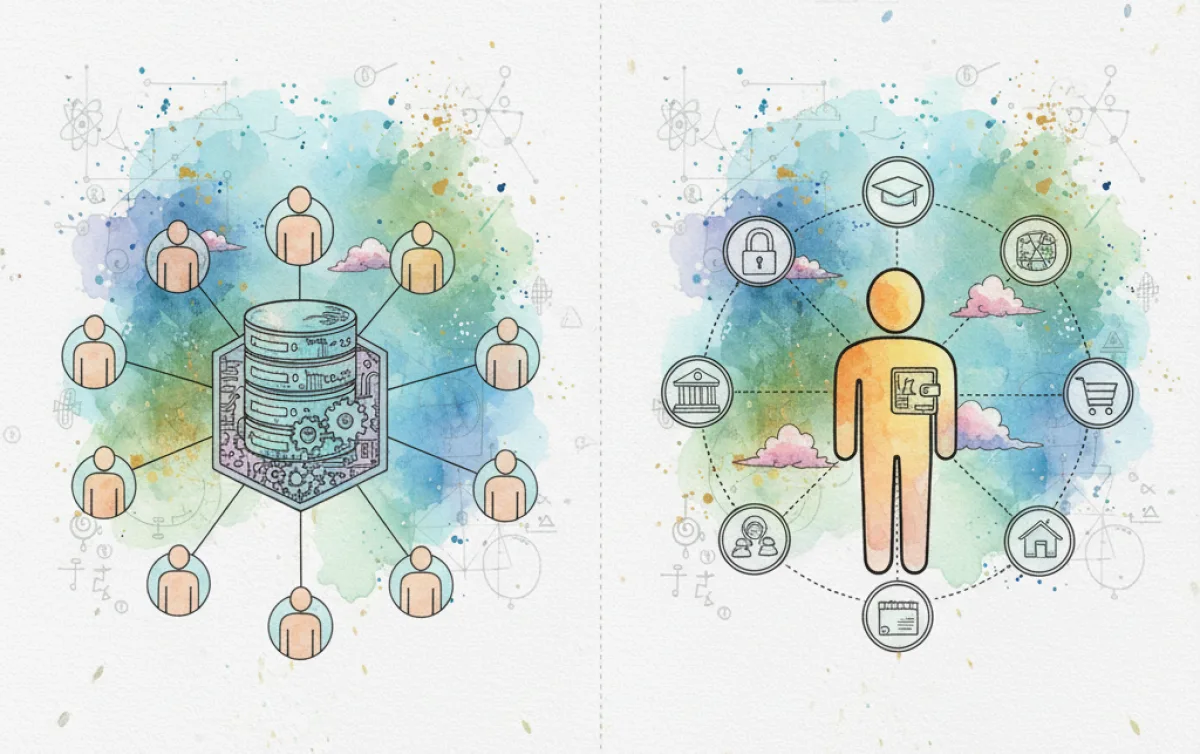
The central problem of digital identity is trust. Proving who you are online almost always requires surrendering control to someone else. Every “Sign in with Google” button offers convenience at the cost of dependence. Your digital life exists at the discretion of corporate gatekeepers who can revoke access, harvest interactions, and monetize your network of relationships.
The & protocol solves this paradox through self-sovereign authentication. You generate and control your cryptographic keys locally, while the system only witnesses and facilitates verification. It never holds the power to lock you out of your own identity. Even if & disappeared tomorrow, your identity would remain intact, portable, and verifiable anywhere.
This architecture balances two competing priorities: security and usability. Your Main Identity Key (MIK) is created using a 12-word recovery phrase combined with mathematical entropy. It’s divided between what you know and what the system helps you generate, removing single points of failure that make traditional passwords and crypto wallets vulnerable. Recovery can happen in two ways: social verification, where trusted contacts confirm your identity, or secret word recovery with built-in time delays that prevent theft. This flexible design reflects a simple truth: a security system that only experts can use fails the people it’s meant to protect. & strengthens security progressively over time, starting with basic authentication and evolving toward biometrics, hardware keys, and verified social recovery. It meets users where they are and grows with their confidence.
Composite Identities: A New Layer of Digital Cooperation
Privacy in & is not only about protection—it’s about enabling secure collaboration. When you invoke a shared identity like &alice&bob&carol, you’re creating a temporary, sovereign entity that can act on behalf of all participants. Each person’s AI agent contributes to group decisions without exposing private data to others, using methods such as encrypted computation and multi-party verification. This mirrors how real-world groups work: families, teams, or communities making collective choices without losing individual privacy. The protocol defines multiple privacy levels—Private, Composite-Private, Negotiation-Public, and Public—reflecting the fact that privacy is contextual, not absolute.
A New Model for Digital Trust
Most identity systems create massive databases that become prime targets for attacks and exploitation. & takes the opposite approach. The more distributed the system becomes, the more secure it gets. Your identity exists as verified cryptographic proof across the network, validated through mathematical consensus rather than corporate approval. When AI agents need to verify who you are or act on your behalf, they rely on proofs, not permissions.
This approach matters because AI will soon mediate nearly every digital interaction—from commerce to communication. Whoever controls authentication will control participation in the digital economy. &’s model ensures that no company, government, or platform can become that gatekeeper.
An Evolutionary Path to a Universal Protocol
The development plan for & moves through three practical phases: proof of concept, progressive decentralization, and universal standardization. Each stage expands reliability, security, and global reach. The long-term vision is simple: authentication should not be a service that companies sell, but a shared protocol that everyone can use—like email or the web.
By rebuilding digital identity around sovereignty, interoperability, and verifiable trust, & turns authentication from a vulnerability into a foundation. It’s the key that makes AI, privacy, and economic participation finally work together.